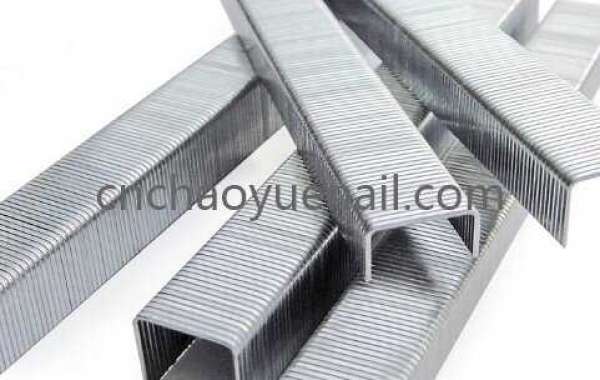
Professional fastening applications often require small steel fasteners that can provide controlled placement while maintaining a clean finished appearance. Fine Wire Staples are manufactured through carefully coordinated material preparation, wire processing, automated forming, surface treatment, inspection, and packaging. The manufacturing objective is not simply to create a shaped piece of steel, but to maintain stable geometry and consistent material behavior throughout high-volume production. This makes process control an important factor for furniture, upholstery, woodworking, packaging, and other assembly applications.
Steel wire is the starting point for the manufacturing process, so raw-material consistency has a direct influence on production stability. Before entering the production line, wire can be evaluated for surface condition, cleanliness, chemical consistency, and mechanical characteristics. Stable incoming material helps reduce unexpected changes during drawing, straightening, and forming. It also supports more predictable machine operation and makes it easier to maintain consistent quality across different production batches.
Wire preparation normally includes drawing and straightening operations. Controlled drawing helps establish a uniform wire condition while preparing the material for subsequent cutting and forming. Lubrication must be managed carefully because excessive friction can influence surface condition and increase equipment wear. Straightening is equally important because automated forming machines depend on stable material feeding. A properly prepared wire can move through guides and forming stations with fewer interruptions and less unnecessary variation.
Automated forming technology converts continuous wire into individual staples through synchronized feeding, cutting, and bending actions. The forming tools determine important features such as crown shape, leg alignment, and overall geometry. Even relatively small changes in tooling condition can influence the finished product, particularly when production runs continuously for extended periods. Precision machine settings and controlled tooling movement therefore help manufacturers maintain repeatable staple shapes throughout a production batch.
Tooling maintenance is closely connected with product consistency. Cutting edges, forming dies, guides, and feeding components are exposed to repeated mechanical movement and gradually experience wear. Preventive maintenance allows production teams to inspect critical components, remove accumulated debris, adjust machine alignment, and replace worn parts before they create widespread defects. A structured maintenance program can also reduce unexpected downtime and support more efficient production planning.
Surface condition is another consideration for steel staples. Depending on the application, appropriate finishing or surface treatment may be applied to improve handling characteristics and provide protection during storage and transportation. Consistency is important during finishing because uneven treatment can affect appearance and product handling. After treatment, inspection can identify visible surface irregularities, contamination, or other issues before the finished staples are packaged.
Fine fastening products are often installed with pneumatic, electric, or other compatible fastening equipment, making feeding behavior an important part of product design. Consistent crown formation and leg alignment can help fasteners move through compatible tools more predictably. If staple geometry varies significantly, feeding or positioning interruptions may occur. For this reason, manufacturing quality needs to consider the interaction between the finished fastener and its intended installation system.
Quality assurance should cover the entire production process rather than relying exclusively on final inspection. Incoming steel verification establishes control over raw materials, while in-process checks can monitor wire feeding and forming stability. Finished-product inspection may examine geometry, alignment, surface condition, and packaging integrity. Automated visual inspection can provide additional support for identifying visible irregularities during continuous production, while batch records improve traceability when quality analysis is required.
Packaging also plays a practical role in protecting finished fasteners. Proper sorting, counting, labeling, and packing help reduce the possibility of mixed products and make inventory management easier for distributors and industrial users. Packaging should also limit unnecessary exposure to moisture and contamination during transportation and storage. Clear batch identification provides useful information for warehouse management and helps customers organize products according to their production or construction requirements.
Material efficiency is becoming increasingly relevant to modern staple manufacturing. Accurate feeding and forming can reduce unnecessary wire waste, while process monitoring can identify conditions that contribute to excessive rejection. Suitable steel scrap can be directed toward established recycling processes. Preventive maintenance also supports resource efficiency by reducing defective production caused by deteriorated tooling or unstable equipment. These practices can improve manufacturing discipline without compromising the focus on product quality.
For buyers, selecting Fine Wire Staples involves more than considering the finished shape. Application materials, installation equipment, surface requirements, storage conditions, and production workflow all influence the appropriate fastening solution. A controlled manufacturing process provides the foundation for stable geometry, consistent material characteristics, and reliable handling across professional applications. Manufacturers, distributors, and industrial buyers can learn more about available steel fastening products and related production capabilities at https://www.cnchaoyuenail.com/product.